Details
AC/DC Wiring Harness Product Line Technical White Paper
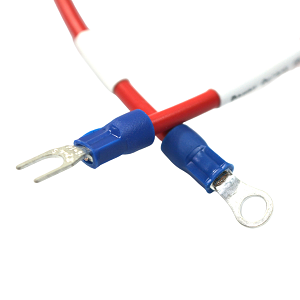
As core components for power transmission and signal connection in industrial equipment, the reliability of AC/DC wiring harnesses directly determines the operational safety and service life of the entire system. This article is intended for engineering procurement and technical decision-makers at industrial power wiring harness customization manufacturers, systematically elaborating on the design logic, technical specifications, selection criteria, and quality assurance systems of customized AC/DC wiring harnesses, helping enterprises achieve optimal power connection solutions under complex operating conditions.
AC/DC Wiring Harness Product Overview from the Perspective of Industrial Power Wiring Harness Customization Manufacturers
In high-end manufacturing scenarios such as automated production lines, energy storage converters, and new energy vehicle charging piles, AC/DC wiring harnesses perform the critical function of efficiently and safely delivering grid power to loads. Unlike standardized mass-produced harnesses, customized AC/DC wiring harnesses require application-specific design in conductor cross-section, insulation materials, connector interfaces, and protective structures based on the specific application environment. By deeply participating in the customer's product development phase, industrial power wiring harness customization manufacturers can provide precise engineering solutions from three dimensions: electrical performance matching, mechanical strength verification, and environmental adaptability validation. Using factory-customized harnesses ensures electrical performance and mechanical strength strictly comply with OEM design standards, avoiding system hazards caused by redundant or insufficient parameters of generic components.
Core Functions and Technical Architecture: Customized Design Logic
The customized design of AC/DC wiring harnesses is not simply changing cable length or connector types, but a systematic engineering effort centered on three major systems: electrical parameters, mechanical structure, and environmental tolerance. Industrial power wiring harness customization manufacturers provide flexible configuration mechanisms based on equipment power ratings, installation space constraints, and operating conditions.
Multi-Level Insulation Solutions and Conductor Selection Basis
For different power densities and application temperature ranges, we provide three levels of insulation material systems: PVC insulation solutions are suitable for conventional industrial environments below 105°C, offering good economy and processability; halogen-free flame-retardant XLPE solutions raise temperature tolerance to 125°C, suitable for rail transit and data center scenarios with strict flame retardancy and smoke density requirements; silicone rubber insulation solutions can operate long-term at 200°C high-temperature environments, suitable for metallurgy, glass manufacturing, and other high-temperature process equipment. Conductors uniformly adopt high-purity tinned copper stranded structures, with wire gauge coverage from AWG 24 to AWG 6. The tinning layer effectively inhibits copper substrate oxidation while enhancing contact stability at terminal crimping points. The multi-strand construction imparts excellent bending and vibration fatigue resistance, meeting long-term usage requirements under moving parts or high-frequency vibration conditions.
Insulation Class Determination Method for High-Power Applications
Determining whether the insulation class of an AC/DC wiring harness meets high-power application scenarios requires comprehensive consideration of three dimensions: First, the continuous operating temperature limit of the insulation material must exceed the sum of the conductor's maximum allowable temperature rise and ambient temperature, with safety margin reserved; Second, the electrical strength (dielectric strength) of the insulation layer must withstand possible transient overvoltages in the system, typically required to be no less than 2 times the rated voltage; Third, for variable frequency drive systems with high harmonic content, the dielectric loss factor of the insulation material must also be evaluated to avoid overheating aging under high-frequency electric fields. Industrial power wiring harness customization manufacturers can issue insulation class matching analysis reports based on customer-provided power spectral density and temperature rise test data.
Technical Specifications and Performance Parameters: Engineering Delivery Standards
The engineering delivery of industrial power wiring harness customization manufacturers strictly follows a parametric design process. The rated voltage range covers AC 100V to 600V, DC 5V to 48V, with support for expanding customization boundaries based on customer requirements. Wire gauge specifications, finished lengths, connector brand models, and protection ratings (IP20 to IP69K) can all be flexibly configured within the technical agreement framework. The following is a reference for typical customization parameter ranges:
| Parameter Category | Standard Range | Customization Boundary |
|---|---|---|
| Rated Voltage | AC 220V / DC 24V | AC 100~600V / DC 5~48V |
| Conductor Specification | AWG 16~12 | AWG 24~6 |
| Insulation Material | PVC (105°C) | XLPE (125°C) / Silicone Rubber (200°C) |
| Protection Rating | IP40 | IP67 / IP69K |
| Connector Type | Aviation Plug | M12 / M23 / Heavy-Duty Connectors / Custom Interfaces |
| Finished Length | 1m / 2m / 3m | 0.1m~50m Arbitrary Customization |
Before installation, confirm rated voltage, current, and wire gauge specifications to ensure compatibility with equipment interfaces. It is recommended to use factory-customized harnesses to ensure electrical performance and mechanical strength comply with OEM standards. We provide detailed technical parameter tables for reference, covering key data such as conductor DC resistance, insulation resistance, withstand voltage test values, and temperature rise curves, facilitating design selection and incoming inspection.
Product Features and Technical Advantages
Fully Traceable Material Management System
Industrial power wiring harness customization manufacturers implement full digital traceability for each batch of harnesses, covering conductor sources, insulation material batches, terminal crimping parameters, and finished product test records. Any harness can be queried for its complete production history via serial number, providing data support for equipment maintenance and fault analysis.
Rigorous Process Quality Control
Terminal crimping adopts a servo closed-loop control system with crimp height tolerance controlled within ±0.02mm, ensuring stable contact resistance. Finished harnesses undergo 100% withstand voltage testing and continuity testing, with sampled products additionally subjected to salt spray testing, vibration testing, and temperature cycling testing to verify long-term reliability under harsh operating conditions.
Flexible Customization Response Mechanism
Customization supports multiple wire gauges, lengths, connector types, and protection ratings, requiring selection of temperature-resistant and flame-retardant materials based on the application environment. We provide detailed technical parameter tables for reference, with dedicated application engineers responding to selection inquiries within 48 hours and completing sample delivery within 7 working days.
Typical Application Scenarios and Selection Guide
AC/DC wiring harnesses are widely used in industrial fields, with significantly different performance emphasis requirements across scenarios. Industrial power wiring harness customization manufacturers provide specialized designs for the following typical scenarios:
- Industrial Robots and Servo Drive Systems:Requires harnesses with high flexibility, bending resistance (cable carrier test ≥5 million cycles), and good anti-interference shielding performance. Recommended silicone rubber insulation + braided shielding structure, with conductors using ultra-fine copper wire stranding.
- Energy Storage Battery Packs and DC Charging Piles:High-current transmission scenarios require focused consideration of conductor temperature rise and connector current-carrying capacity. Recommended halogen-free flame-retardant XLPE insulation solutions, with temperature sensor harnesses configured for overheat protection interlocking.
- Photovoltaic Inverters and Wind Power Converters:Outdoor installation environments require harnesses with excellent UV aging resistance, moisture-heat resistance, and wide temperature range operation capability (-40°C~+125°C), with protection ratings reaching IP65 or above.
- Semiconductor Manufacturing Equipment:Cleanroom environments have strict requirements for particle release; harness jackets must use low-outgassing materials and avoid easily dust-generating braided mesh sleeves.
Quality Assurance and After-Sales Service System
Industrial power wiring harness customization manufacturers provide comprehensive quality assurance commitments. All products enjoy a one-year warranty, with warranty coverage including: material defects, manufacturing process issues, and substandard performance parameters. Under normal usage conditions, if quality issues such as insulation aging, conductor breakage, or poor contact occur, free repair or replacement services are provided. Human damage, improper installation, and usage beyond technical parameters are not covered by the warranty.
During batch order execution, we implement a three-level quality control system: incoming inspection, in-process inspection, and finished product testing. The incoming stage performs sampling inspection on copper wire purity and insulation material flame retardancy ratings; the process stage sets up key process mutual inspection points; the finished product stage performs full electrical parameter inspection with test reports retained. For quality issues within the warranty period, we commit to providing a handling plan within 48 hours of written notification, offering return-to-factory repair or on-site replacement services based on the nature of the fault.
Installation Specifications and Compatibility Verification
Correct installation procedures are the prerequisite for ensuring long-term stable operation of AC/DC wiring harnesses. Before installation, confirm the matching of rated voltage, current, and wire gauge specifications with equipment interfaces to avoid overheating risks from undersized conductors. After connectors are fully mated, use a torque wrench to tighten according to specifications, ensuring the shield layer forms 360° continuous grounding with the connector housing. For outdoor or humid environments, check seal ring integrity and apply specialized lubricating grease.
Common compatibility faults include interface dimension deviations, poor terminal crimping, and reverse polarity connection. Industrial power wiring harness customization manufacturers recommend verifying interface fit using industrial borescopes or go/no-go gauges during first article installation, and performing polarity continuity testing on harnesses. Using factory-customized harnesses can minimize the above risks to the greatest extent, as connector selection, terminal crimping parameters, and wire sequence definitions have all undergone matching verification with equipment interfaces.
FAQ - Common Technical Consultation Answers
How to determine whether the insulation class of an AC/DC wiring harness meets high-power application scenarios?
Three indicators must be comprehensively evaluated: insulation material continuous operating temperature, dielectric strength, and dielectric loss. First, confirm the insulation material rated temperature exceeds the sum of conductor maximum temperature rise and ambient temperature; second, verify the insulation layer withstand voltage is not less than 2 times the system's maximum transient voltage; for variable frequency drive and other harmonic-containing scenarios, high-frequency dielectric loss must also be evaluated. It is recommended to provide equipment power spectral density data for special verification by our application engineers.
What key parameters should be noted during AC/DC wiring harness installation to ensure compatibility?
Before installation, confirm rated voltage, current, and wire gauge specifications to ensure compatibility with equipment interfaces. Focus on verifying connector model consistency with equipment sockets, terminal definitions matching schematics, and harness length reserving reasonable bending radius. It is recommended to use factory-customized harnesses to ensure electrical performance and mechanical strength comply with OEM standards.
How to confirm the minimum order quantity, sampling cycle, and mass production delivery time for customized harnesses?
The minimum order quantity depends on harness complexity; MOQ for conventional harnesses is 100 pieces, negotiable lower for complex integrated harnesses. The sampling cycle is typically 5~7 working days, and mass production delivery time is 10~20 working days depending on order quantity. Rush orders can be coordinated for dedicated production lines.
Are non-standard connectors and special protection ratings (such as IP67/IP69K) supported for customization?
Yes, supported. Customization supports multiple wire gauges, lengths, connector types, and protection ratings, requiring selection of temperature-resistant and flame-retardant materials based on the application environment. IP69K protection ratings require specialized sealing structures and high-weather-resistance jacket materials; we can provide corresponding solutions.
What is the response time for repair or replacement if quality issues occur within the warranty period?
All products enjoy a one-year warranty, with warranty coverage including: material defects, manufacturing process issues, and substandard performance parameters. Under normal usage conditions, if quality issues such as insulation aging, conductor breakage, or poor contact occur, free repair or replacement services are provided. We commit to initiating the handling process within 48 hours after confirming the cause of failure.
What are the structural differences between high-flexibility cable carrier harnesses and conventional fixed installation harnesses?
Cable carrier harnesses use ultra-fine copper wire (0.05mm~0.08mm) compound stranding structures, with insulation layers made of high-elasticity materials and aramid yarn fillers added for tensile strength. Conductor stranding pitch is optimized to ensure internal stress dispersion during continuous bending.
How to select the flame retardancy rating of harnesses? What is the difference between VW-1 and UL94 V-0?
VW-1 is a single-wire vertical burn test rating under the UL1581 standard, applicable to electronic wire harnesses; UL94 V-0 is a plastic material flame retardancy rating, targeting the insulation material itself. Industrial equipment is recommended to select products meeting both VW-1 harness rating and UL94 V-0 material rating.
How does the grounding method of shielded harnesses affect EMC performance?
Shield grounding should adopt 360° ring grounding, avoiding pigtail-style ground wires. Ground impedance should be less than 10mΩ, and the shield should be directly connected to the metal housing at the connector end. For high-frequency interference scenarios, dual-end grounding is recommended.
How to verify whether the temperature rating of a harness truly meets specifications?
Verification can be performed through thermal aging tests, placing samples at rated temperature for continuous operation of 2000 hours, testing insulation layer tensile strength retention rate and dielectric strength changes. Industrial power wiring harness customization manufacturers can provide third-party test reports.
How is the current-carrying capacity of a harness calculated? What is the correspondence with wire gauge?
Current-carrying capacity depends on conductor cross-sectional area, insulation material temperature rating, and environmental heat dissipation conditions. AWG 18 wire gauge at 30°C ambient temperature has a typical current-carrying capacity of approximately 7A, AWG 12 approximately 25A. Specific derating calculations must be performed based on temperature rise limits.
Do customized harnesses provide wire sequence definition and marking services?
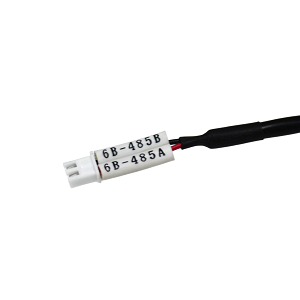
Yes, provided. We can print wire number markings at both ends of harnesses per customer requirements, or use different colored wires to distinguish functions. Marking methods include heat-shrink tube printing, inkjet coding, and label application, meeting different maintenance level requirements.
Can AC/DC wiring harnesses transmit power and signals simultaneously?
Yes, possible. We support composite harness designs that integrate power cores and signal cores within the same jacket, isolating interference through internal shielding layers. Note that sufficient spacing should be maintained between signal wire pairs and power wires, or independent shielding structures should be adopted.
What is the minimum bending radius for harnesses?
For fixed installation scenarios, the recommended bending radius is no less than 4 times the harness outer diameter; for cable carrier motion scenarios, no less than 7.5 times the outer diameter. Excessive bending radii can cause conductor fatigue fracture or insulation layer cracking.
How to determine whether a harness needs a shielding structure?
When harnesses are near strong interference sources such as variable frequency drives and servo drives, or when transmitting signal levels below 24V with frequencies above 1kHz, shielding structures are recommended. Industrial site electromagnetic environments are complex; EMC pre-testing is recommended during the solution review phase.
What is the shelf life of harnesses? Does long-term storage affect performance?
Under storage conditions of 25°C±5°C temperature and humidity below 60%, the harness shelf life is 3 years. Beyond the shelf life, insulation resistance and withstand voltage testing must be re-performed before use. Our products are all marked with production dates.
Certifications and Technical Support
Industrial power wiring harness customization manufacturers have passed ISO9001 quality management system certification and IATF16949 automotive industry quality management system certification, with products compliant with RoHS and REACH environmental directives. We possess UL-certified harness processing capabilities and can assist customers with UL certification applications and factory audit support.
For detailed technical parameter tables, selection guidance, or sample testing, please contact our application engineering team. We provide full lifecycle technical support from solution review, sampling verification, to batch delivery, ensuring every AC/DC wiring harness performs optimally in your equipment.
About Winna Technology
Winna Technology specializes in power adapters, AC/DC cable harness customization, and ultrasonic metal welding equipment R&D and manufacturing, providing one-stop OEM/ODM services.
Our products are CE/UL/FCC/CCC/RoHS certified, with an annual return rate below 0.02%, serving customers in 50+ countries and regions worldwide.
AC/DC Cable Harness and Flat Connector Assembly
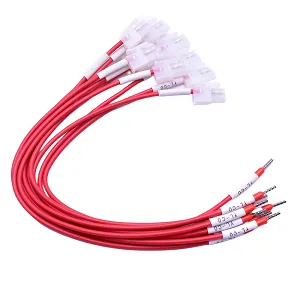
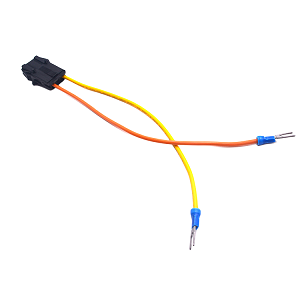
Winna Technology manufactures custom AC/DC cable harnesses, flat connector assemblies and complete wiring groups. From a single crimped wire to a fully assembled harness with heat shrink, labeling and electrical testing, you get everything from one supplier.
Products and services
- AC power cords and DC connection cables in common standards
- Flat connectors and receptacles (2.8 mm, 4.8 mm, 6.3 mm), insulated or bare
- Wiring for industrial equipment, vehicles and energy storage
- Crimping, heat shrink, labeling and connector assembly
Materials and workmanship
| Conductor | Tinned copper |
| Insulation | PVC, XLPE or silicone, including heat resistant types |
| Cross section | 0.5 to 6 mm², larger on request |
| Testing | Continuity, pull force, visual inspection |
From sample to series
- Send drawing, BOM or sample
- Feasibility review and quotation
- Sample build and approval
- Mass production with test report
- Packing and shipping
FAQ
Can you manufacture to our drawing?
Yes. We work from drawings, BOMs or physical samples.
Do you supply complete harnesses?
Yes, including connectors, heat shrink, labeling and packaging.
What testing is available?
Continuity, pull force and visual inspection, documented in a test report.
Contact: sale@winna-group.com or WhatsApp +86 134 1065 0093.
Specifications
AC/DC Cable Harness and Flat Connector Assembly
Winna Technology manufactures custom AC/DC cable harnesses, flat connector assemblies and complete wiring groups. From a single crimped wire to a fully assembled harness with heat shrink, labeling and electrical testing, you get everything from one supplier.
Products and services
- AC power cords and DC connection cables in common standards
- Flat connectors and receptacles (2.8 mm, 4.8 mm, 6.3 mm), insulated or bare
- Wiring for industrial equipment, vehicles and energy storage
- Crimping, heat shrink, labeling and connector assembly
Materials and workmanship
| Conductor | Tinned copper |
| Insulation | PVC, XLPE or silicone, including heat resistant types |
| Cross section | 0.5 to 6 mm², larger on request |
| Testing | Continuity, pull force, visual inspection |
From sample to series
- Send drawing, BOM or sample
- Feasibility review and quotation
- Sample build and approval
- Mass production with test report
- Packing and shipping
FAQ
Can you manufacture to our drawing?
Yes. We work from drawings, BOMs or physical samples.
Do you supply complete harnesses?
Yes, including connectors, heat shrink, labeling and packaging.
What testing is available?
Continuity, pull force and visual inspection, documented in a test report.
Contact: sale@winna-group.com or WhatsApp +86 134 1065 0093.